 Though the day was drawing on, we hastened a few miles up the Severn valley to the ancient Roman Legionary fortress of Wroxeter, which we had long intended to visit. Above you see the Severn peacefully meandering, a few miles upstream from Ironbridge.
 Alas, the Autumn season had just started, and the Wroxeter site was closed. But here is (as far as I know) the tallest bit of Roman wall standing in the Midlands of England – we just couldn’t get any closer to it than this. The hill known as the Wellington Wrekin broods a few miles away on the right of the shot. Wroxeter, or Viroconium Cornoviorum, to give it its original name, had the 14th Roman Legion based there from about 58 AD – which is very early in the Roman conquest of Britain; that had only ‘officially’ begun in 43 AD. A Roman Legion was supposed to consist of about 5,000 men. Later the 20th Legion was there, but according to Wikipedia, they withdrew around 88 AD. But a significant town had grown up around the military fort, as usually happened, and the settlement remained, and grew, for a long period. It may have grown to have as many as 15,000 inhabitants; if so, it might then have been the fourth largest city in Britain. However, it later died out and was totally abandoned. Usually, sites adopted by the Romans developed and remained in use forever after: Chester, Leicester, London &c. But these usually already existed as British towns, and so the Romans occupied sites that had already been proved satisfactory, since remote times. To found an ambitious new settlement (or to base one on a small ‘unproven’ British site) might have carried unanticipated risk. It has been suggested that Wroxeter was prone to flooding from the river Severn; and that part of its name may refer to an earlier British hill fort resourcefully situated on the hill called the Wrekin, to be seen in the above image. In that case, the Britons knew better than the Romans as regards the risk of floods. But who knows? The only other known significant Roman settlement that was also totally abandoned was Silchester; but that need not concern us here. (Though it would be fun to Google around a bit on that subject…) 8^)
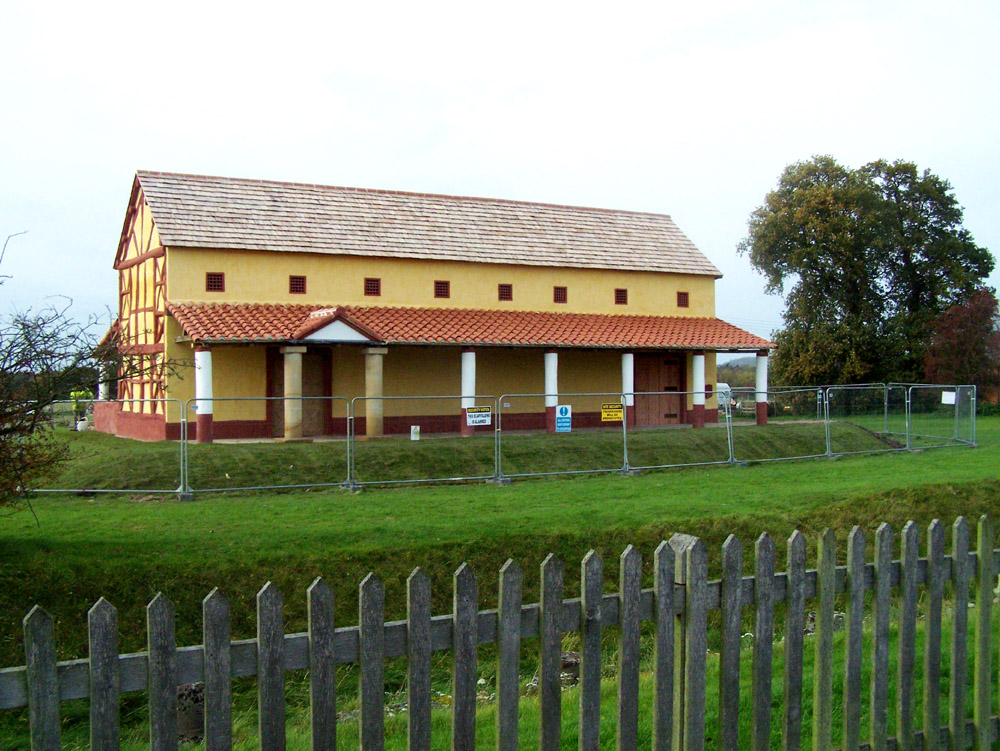 Here you see a replica Roman building that has been constructed at Wroxeter. It will be good to go back in 2011 and see how it’s getting on, and what it represents, &c.
Actually, we didn’t make it back until 2014, but then we got some good images, which are on the next thumbnail down!