 13th October 2012. Moseley Old Hall is now rather oppressed by the M54 motorway, as it lies about half way between Wolverhampton and Cannock. It is most famous because after the Battle of Worcester in 1651, Charles II took refuge here for a day or two. Not having visited it before, we were rather surprised to find a relatively unspectacular building. But underneath the brickwork – which was applied about 1870 ‘to stop the place falling down’, is a genuine half- timbered house dating back to 1600. Look:
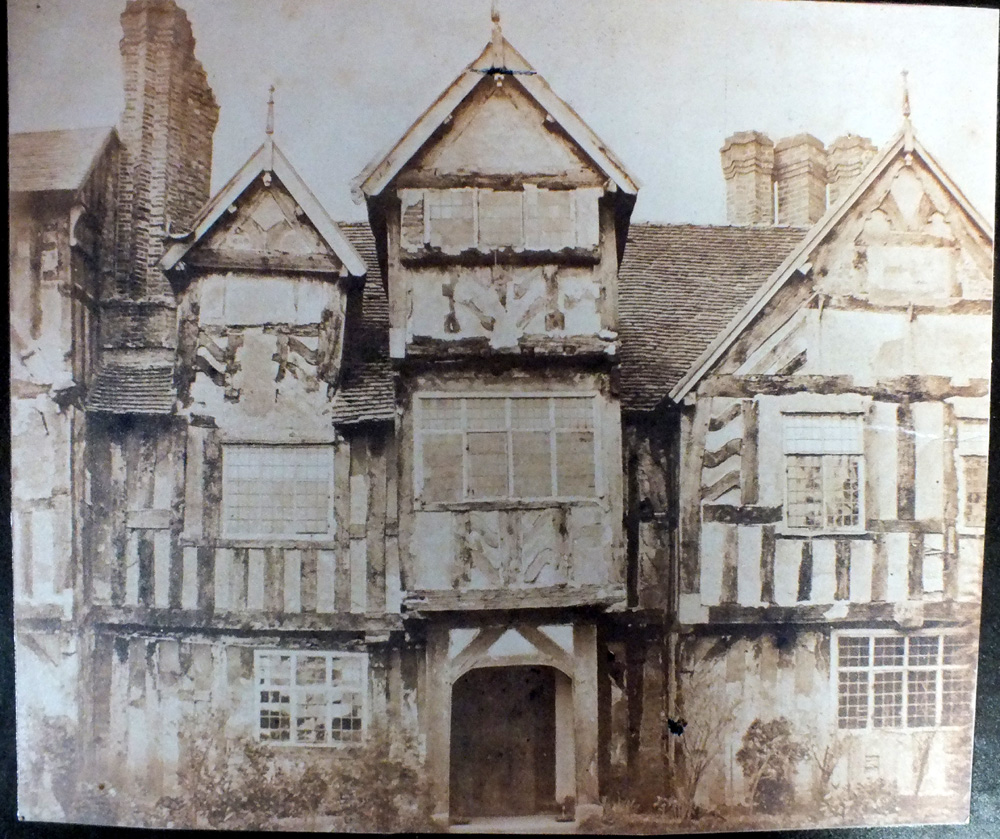 This is a photograph (not a drawing) of it, shortly before it was repaired & bricked over.
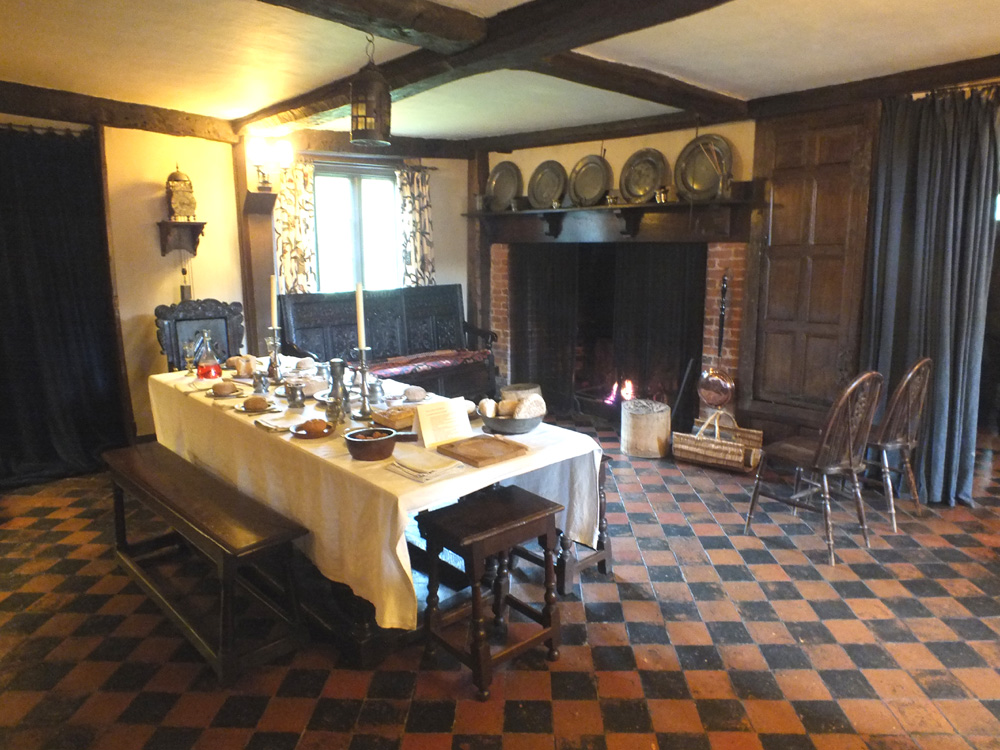 A table setting such as King Charles may have had while he was here – assuming the coast was clear. Normally, the King stayed in one of the three ‘Priest Holes’ the house has.
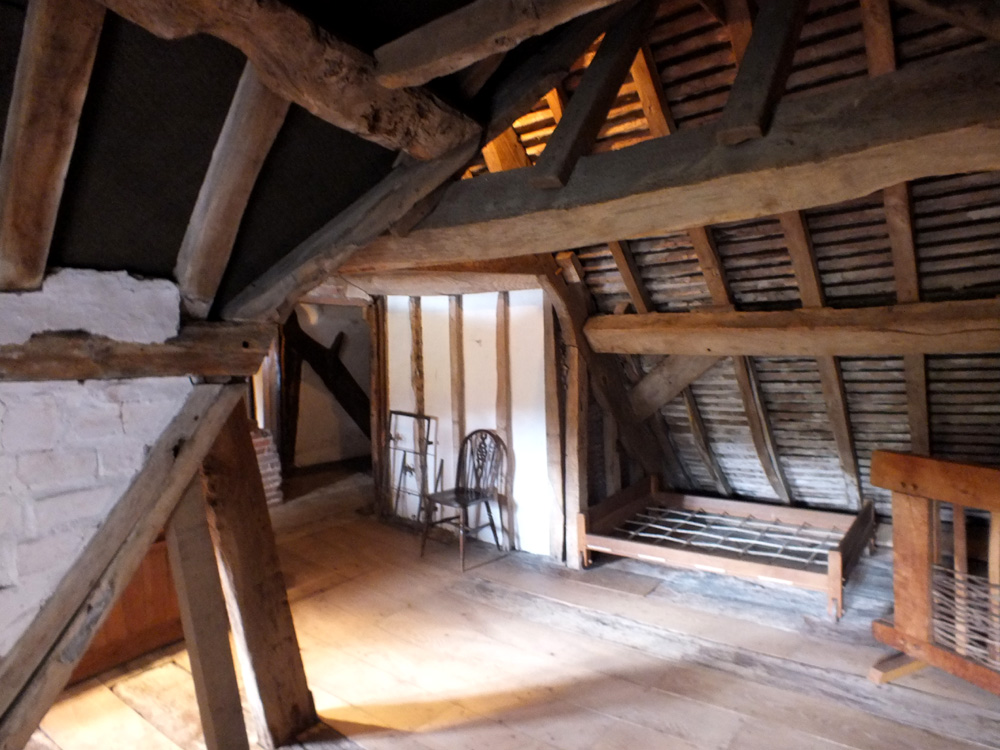 Up in the roof space. There is also a Chapel up here. Note the bed right of centre, with its crossed rope support. Servants would have slept up here. The rope would get stretched & periodically need the slack taken up – this is the origin of the phrase ‘Sleep tight!’ Our guide told us several of these fascinating word and phrase origins, besides a detailed history of the house. See also: http://www.nationaltrust.org.uk/moseley-old-hall/
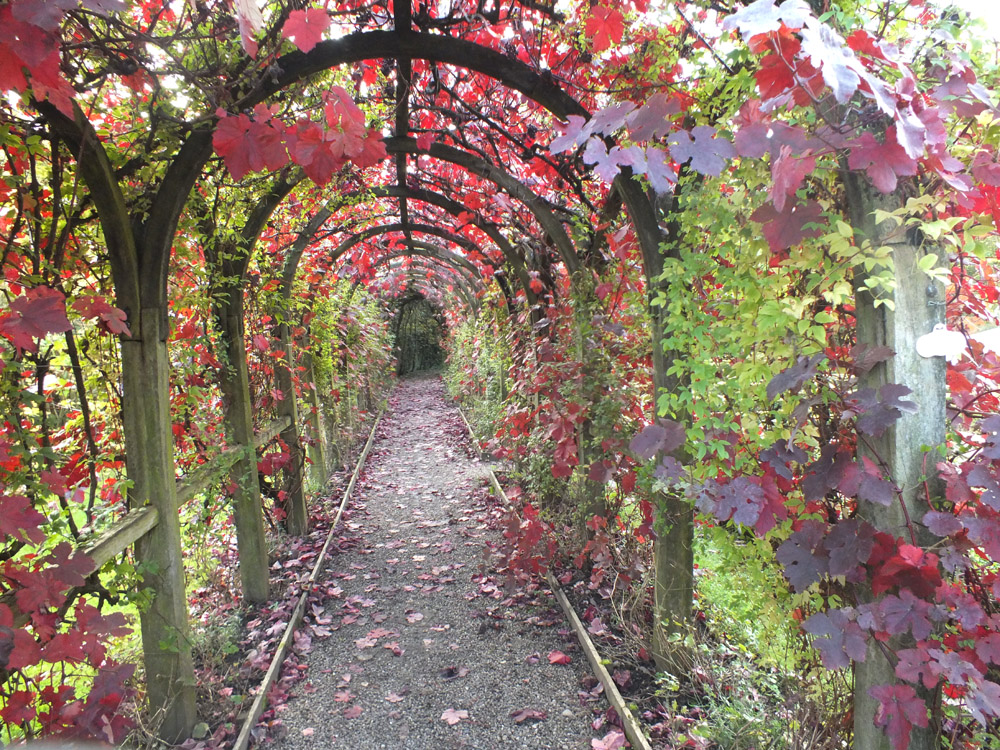 Beautiful effects of light in the ‘grape vine walk’. Alas, this was later blown down in a gale, and although a copy of the wooden frame has been put in place, the vines have not yet had time to grow, as we saw on a later visit.
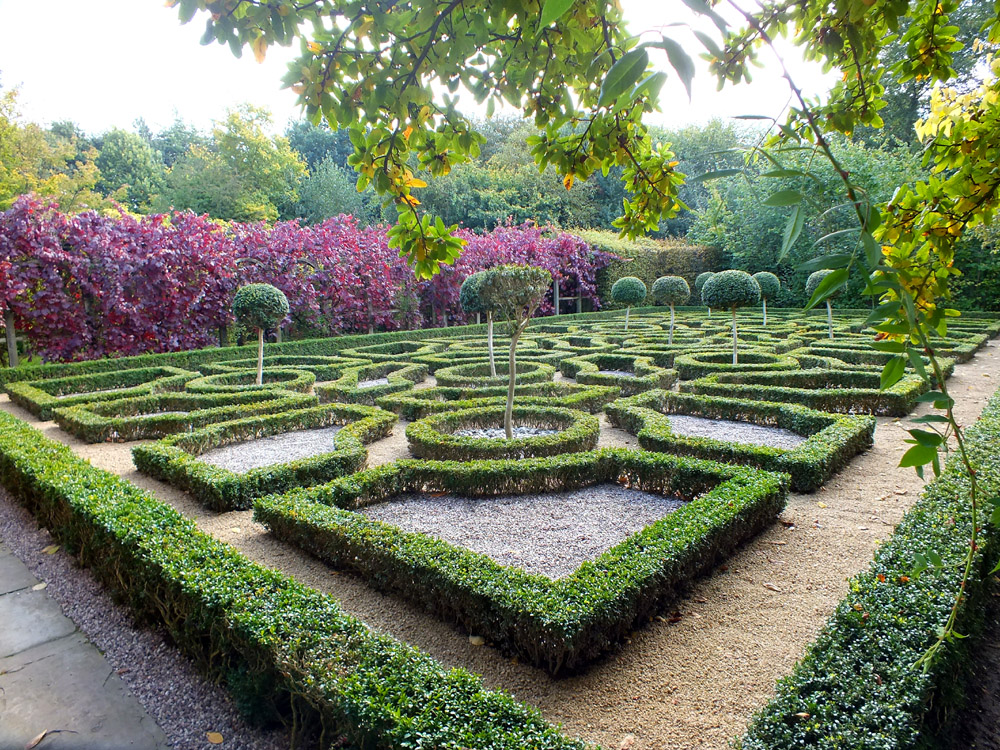 A traditional knot garden, with the ‘vine walk’ in the background. Wikipedia tells us: “A knot garden is a garden f very formal design in a square frame, consisting of a variety of aromatic plants and culinary herb including germander, marjoram, thyme, southernwood, lemon balm, hyssop, costmary, acanthus, mallow, chamomile, rosemary, Calendulas, Violas and Santolina. Most knot gardens now have edges made from box (Buxus sempervirens), whose leaves have a sweet smell when bruised. The paths in between are usually laid with fine gravel. However, the original designs of knot gardens did not have the low box hedges, and knot gardens with such hedges might more accurately be called parterres. Most Renaissance knot gardens were composed of square compartments. A small garden might consist of one compartment, while large gardens might contain six or eight compartments.
leave the below text for now…
3rd November 2012. After a lot of work on 78 rpm records, fresh air was obtained on a very nice day. We are sat on the top of Windmill Hill, part of the Waseley Hills Country Park, near Birmingham but actually in Worcestershire. The red arrow indicates a clump of trees on another hill, Frankley Beeches. We have been to that hill before (Diary 37) and took a zoom shot from there into the centre of Birmingham. Windmill Hill is in the same direction, so we screwed our new camera up to maximum zoom…
…which worked quite well considering we had no tripod. There is Frankley Beeches, and the centre of Brum behind. The 500 ft Post Office Tower pierces the sky to the left of the trees, and the blue-tinted tall building to the right is 10, Holloway Circus, the tallest inhabited building in Brum, at 427 ft (130m).
5th November 2012. We are not venturing too far from home at the moment, but there is no shortage of ‘autumn tints’ locally. These two are in the Grove Park, Harborne. We have been here before in December 2011 – Diary 38.
25th November 2012. Another return visit to Woodgate Valley country park. In spite of the clear sky, there has been a great deal of rain in the last few days, and indeed serious flooding has occurred in some areas. Even the little Bourne Brook (its source is only about a mile away) is carrying quite a bit of water. In summer it is often only a trickle, though it never actually dries up, as far as I know.
The paths indicate how wet it still is. Fortunately we had remembered to take our walking boots, or we would have had to give up.
Unfortunately, though we could shoot this Great Spotted Woodpecker Dendrocopos major at maximum zoom, there are twigs in the way. It’s a male, as apparently the female has no red on the back of its head; while young ones – presumably of both sexes – have red on the tops of their heads. Cloud began to drift up by about 1300, and it became colder without the sun. However, we had covered our two miles, so honour was more or less satisfied. After a cup of tea and a bun in the Visitor Centre, we came back home to finish this page.
Page finished 25th November 2012.