16th November 2011. We are now getting into our long-deferred Sabbatical Leave from playing music & gigs. It’s something we’ve wanted to do for years. No matter how enjoyable some of the gigs are, travelling the length & breadth of the country is increasingly stressful as we get older & older. Anyway! The Sabbatical (it’s meant to last a whole year) has begun; and the first Major Leisure Project we are undertaking actually has nothing to with the nice restful scenes below. No; the Project is to compile a list of all the British Disc Record Companies (and illustrate their labels) from 1898 to circa 1923. (There were some disc records around earlier; but 1898 is generally accepted as the start of ‘disc records as we really know them’.) Two days in front of the PC has given us a very promising start, and naturally, the eventual list will appear (D.V.) elsewhere on this shoddy & disreputable website. However, we are currently enjoying the most glorious weather for November that I can recall; so it seems a pity to waste it. Besides, as it were, one needs to increase the focal length of one’s eyes from time to time. In simpler times, psychologists used to call this ‘Exteriorisation’. If one sits looking at a blank wall (or indeed a PC monitor) for countless hours, one’s spatial awareness can become – impoverished, shall we say? Reality, if I may use such a vague term, lies on the outside: in the landscape, in Nature, in the sky; in birds, animals, plants. To lose touch with Nature is, I think, a very regrettable thing. When you have been concentrating on a PC screen for many hours or even days, it only takes half an hour or so walking in the open air, drinking in the space, both metaphorically and literally, for you to start yawning copiously. At least, I usually start yawning. It’s nothing to do with being tired – even if one is actually is physically tired; it’s more a process of exchanging your accumulated confinement for the infinite space outside. As I said, you ‘exteriorise’ yourself by looking at things far away, and accordingly feel refreshed. Or perhaps I’m just a silly old prat that rambles on about obsolete & outmoded ideas? 8^) Anyway, out we went!
 Oh, look! It’s the lake at Leasowes Park, Halesowen. I can’t tell you what ‘Leasowes’ means, but this large and now public park was apparently the grounds of Leasowes House, which belonged to William Shenstone (1714 – 1763). He was a poet, and above all, a pioneer of landscape gardening. After total neglect, a long and extensive restoration work is being carried out by Dudley MBC. Though Halesowen borders the open countryside, resources such as this are extremely important, as a large population of the West Midlands are confined within our huge conurbation, and need very much such parks as this.
 We only live about 3 miles from here, and come to Leasowes fairly often. Because of the long, hot dry summer of 2011, we were expecting unusually nice autumn coloured leaves. But the weather has remained so mild, some of the trees aren’t really sure what to do.
 While many leaves have fallen, others are still very green.
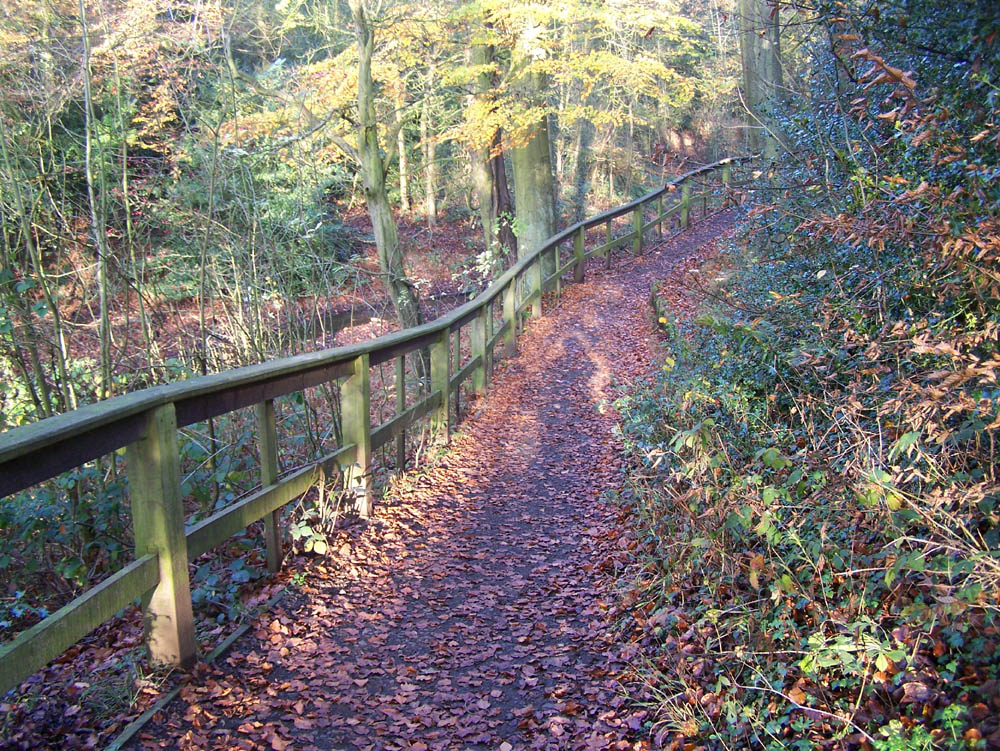 Here we have a path leading down, near to a small stream which flows along a little valley. We took a sample of water from it, and examined it for the presence of diatoms. Perhaps we have neglected to tell you, but looking for diatoms in rivers, ponds and streams is now one of our new hobbies, as more leisure time has gradually become available to us. These days, the abundance and diversity of diatom species has come to be a simple and quick way of evaluating the purity of ponds and watercourses. Of course, the more pure the water is, the more species there are, and the more abundant each species is. It’s early days for us yet in this revival of an interest which dates back to our schooldays. As yet, we have no camera or imaging device to attach to our battered old microscope. Eventually though, you may be bored with images of diatoms on these pages! There are apparently about 2,500 species of diatoms in the British Isles. So far, many of them look the same to me. Diatoms are tiny plants, generally about 100 microns or so (one tenth of a millimetre) long, though some are much larger & some smaller. They have two-part ‘shells’ or frustules as they are properly called. These frustules are apparently made of silica, in effect glass. How a microscopic plant, relying on chlorophyll for photosynthesis, can possibly make a shell for itself out of glass is quite beyond me at the moment. There were very few diatoms in the sample. But this stream is well shaded, and plants rely on light. And the days, however bright they may be, are very short at the moment. Or perhaps the stream is very polluted? Who knows?