A SHORT TRIP TO OXFORD AND ITS MUSEUMS.

August 2017. Or at least, just three of them; for Oxford has been a centre of learning for over 800 years, and has many historic museums and libraries! We have been in Oxford quite a few times in the past, but always in connection with work; so there were hardly any opportunities to visit places of interest. Only half an hour in the Ashmolean Museum is a most frustrating thing. But we are retired now, and as a special treat for Fathers’ Day, my kids very generously gave me a night in the legendary Randolph Hotel (above) – the hotel in Oxford. Whoopee! Now for a cultural Feast…
We arrived by train on Monday afternoon, when some of the museums are closed, but the Natural History Museum was open, so we set out along Broad Street. Now the reason for most of my previous trips to Oxford was to play on jazz gigs, and walking along that famous thoroughfare, packed with tourists, we saw the site of one of my most agonising gig experiences. It may amuse you…
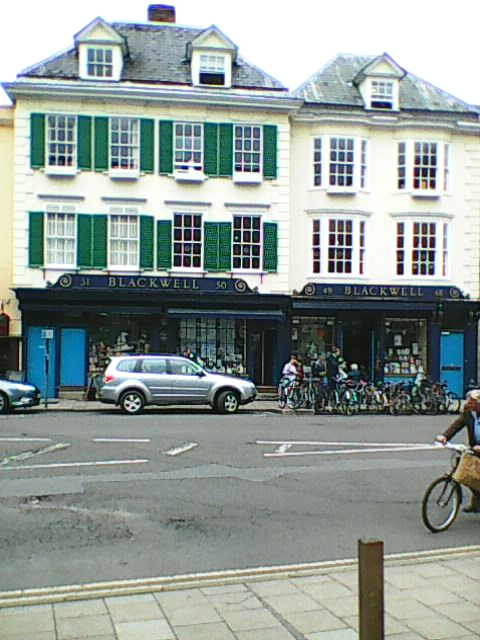
Blackwell’s Bookshop (only part of it is seen above) has been the most celebrated bookshop in Oxford for ages. Its 125th Anniversary occurred about 10 years ago, and among the general festivities, they had an open evening in the shop with guests, drinks, nibbles &c., and some background music from a jazz quartet. I was recovering from the ‘flu, so I made sure of getting there very early, to avoid tiring stress &c. I parked the car in St. Giles (just around the corner), dropped off my instruments in the shop in the place we were to play, and went out to get a cup of coffee. With half an hour still to spare, I was returning to Blackwell’s when I met two more of the band, including the leader. I chanced to say I had parked in St. Giles & would need to move the car later in the evening. He said there was no reason for that. I could park in the centre of Broad Street, just as he had done. Sure enough, there were quite a few spaces left. So I went back to St. Giles, got the car and made to turn left into Broad Street. Only you couldn’t, because there was a row of bollards blocking it off. So I carried on, trying to find a left turn & get into Broad Street from the other end. They were all ‘No Entry’. We got further and further from the centre of Oxford, and with the intervention of the Devil, we got completely lost, and ended up on the Oxford Eastern by-pass. Thus we were compelled to drive north, round the main Northern by-pass road, then back down the main road, some 6 or 8 miles in heavy traffic into… St. Giles, which we had left half an hour before. The car ended up virtually in the same place, while I had gradually turned into a sweat-soaked gibbering idiot. The band had, of course, started playing some time before I got back.
To arrive an hour before everybody else, and yet still be late for the gig, I can tell you, is an experience I would not wish on Attila the Hun.

This is the Holywell Music Room. Oxford can claim many ‘firsts’, and this is but one. Dating from 1748, it was the first custom-built concert hall in Europe. My memories of the two or three gigs I did there are entirely happy ones. It is not terribly large, seating rather under 200. It has a bright acoustic, and a fine, relaxed atmosphere – in 270 years, it seems to have acquired a benign and genial persona of its own. Besides, the King’s Arms is to hand at the end of Holywell street, where a soothing drink may be taken before the gig, just to calm the butterflies.
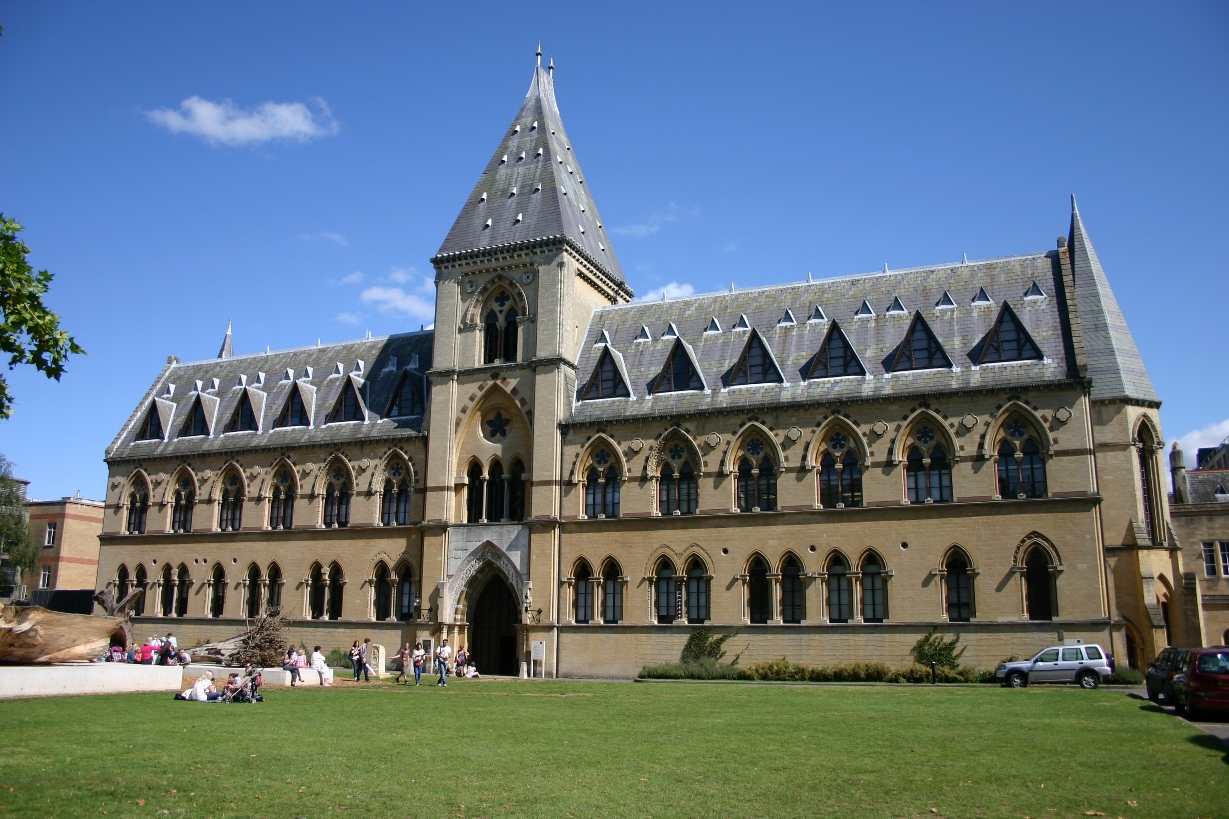
This is the Museum of Natural History, built around 1860, a superb example of Victorian architecture in its own right. We spent a good couple of hours looking round, and it was good to see so many children eagerly examining exhibits, and some of the younger ones involved in all sorts of creative activities in the central area. We only have two images for you:
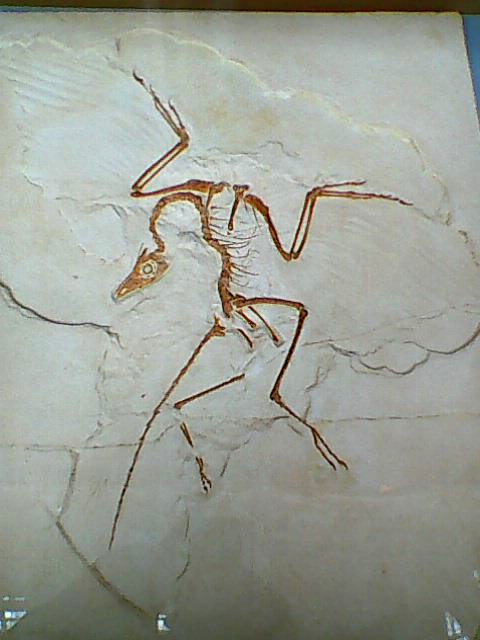
There’s definitely something about an Archaeopteryx. As I type, Windows is rejecting my spelling, but I am confident about it, and so reject Windows. (The concept of life without MS Windows, attractive as it is, would probably result in the collapse of World Civilisation within 36 to 48 hours – a week at very most, so I guess we’re stuck with it.) As I was saying, the Archaeopteryx. There used to be – perhaps still are – people who insist that these things never existed and are just groups of bones which were tossed together by chance 100 million years ago & got fossilised into a plausible-looking proto-bird. Monkeys & typewriters sort of thing. For a long time, there was only one known example of an Archaeopteryx, but there are quite a few now, I think. Several, anyway. To be sure, when there was only one known specimen, the temptation to fake another would have been strong. But if you want to read about faking creatures which are in demand, H.G. Wells’s marvellous short story ‘The Triumphs of a Taxidermist’ is what you need. It’s only a few pages long – pages of sheer delight. In fact, since all Wells’s short stories are on Project Gutenberg, they must be out of copyright; so here is a link to the story. It will only take you a few minutes to read. And if you do not come back here afterwards, but go on to Gutenberg and download all the others, I shan’t mind at all. In fact, I shall be delighted at having introduced someone else to those excellent gems.
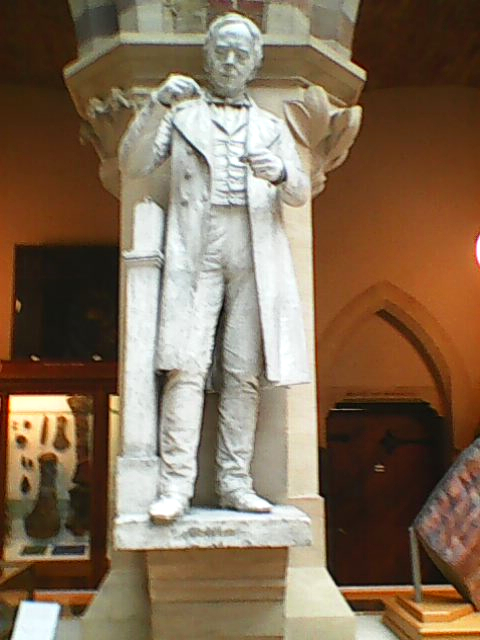
Natural History was more broadly based years ago, so we were not really surprised to find a statue of Hans Christian Oersted in the museum. He established the connection between magnetism and electricity around 1820, thus putting in place a vital foundation stone for the utilisation of electricity in the service of mankind.

The next morning, we were on the steps of the Ashmolean Museum when it opened, and spent over three hours there. It is futile to describe anything we saw, there was so much. And of course, there is ‘museum fatigue’. But what often happens in a museum, at least to me, is that you see something quite small, or minor, tucked away in a corner, or at the bottom of a display case, which suddenly gives you a little electric shock of surprise & delight. This time it was an inscribed stone.
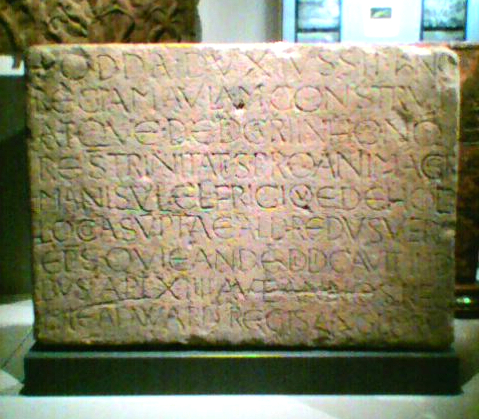
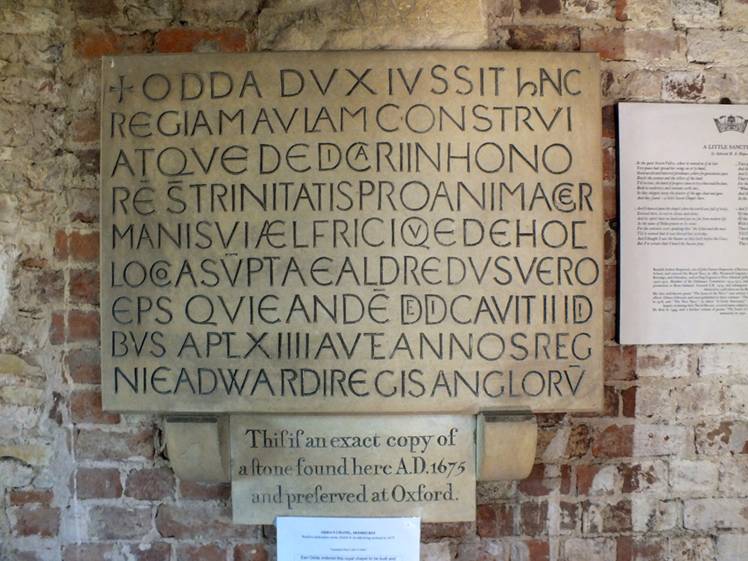
On the left, is the late Anglo-Saxon stone in the Ashmolean. It records the dedication of a ‘Royal Hall’ as a chapel to one Odda, in 1056. On the right, you see a photo I took in September 2012 in the actual chapel, at Deerhurst in Gloucestershire. A replica of the stone is seen, and below it the note: ‘Thiſ iſ an exact copy of a ſtone found here A.D. 1675 and preſerved at Oxford.’ Aha! Unintentionally, I had run the original stone to ground. I will leave it to experts in late Anglo-Saxon inscriptions to confirm that the copy is indeed accurate. My photos of Odda’s Chapel can be found here .

More prosaically, here is a shot of the museum café in the basement of the Ashmolean. It appears here because I once did a gig at a wedding breakfast held here – for you may hire the room for such purposes. Many museums and institutions these days use their facilities for special events, in order to assist their funding. The acoustics in here, as one would expect, are extremely reverberant.
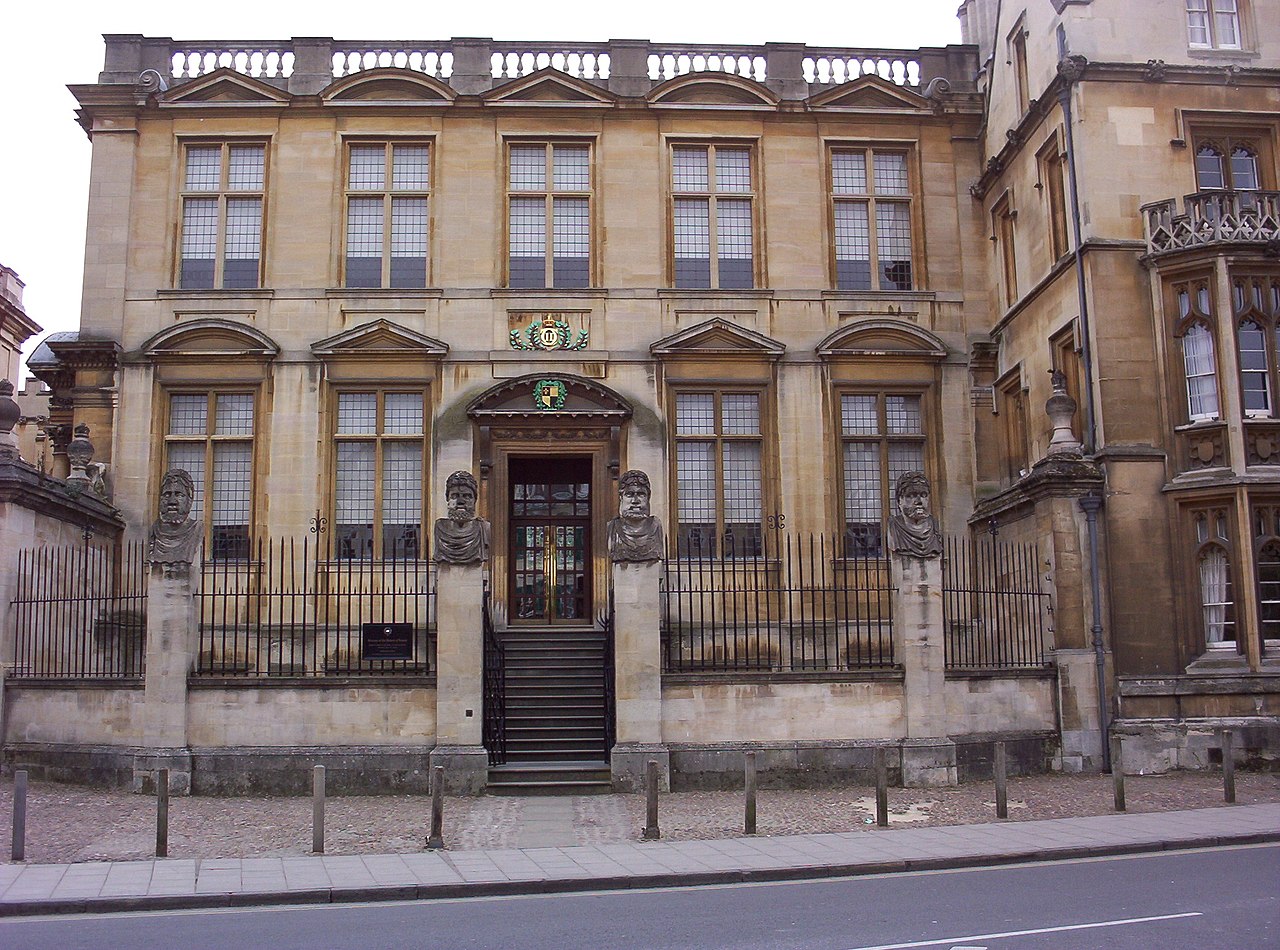
Our last port of call was the Museum of the History of Science. Now: this was the original Ashmolean Museum building. It dates from 1683, and the basement was the original Chemistry Laboratory of the University. It became the M.H.S. in 1924. It has a truly amazing collection of microscopes, telescopes, navigational instruments, clocks and indeed, all sorts of ‘Philosophical Instruments’ as the old phrase so delightfully has it. Again, no adequate description can be made here; you must try to visit all these places if you possibly can. However, in the small corner of a large display case, we received another marvellous burst of delight.
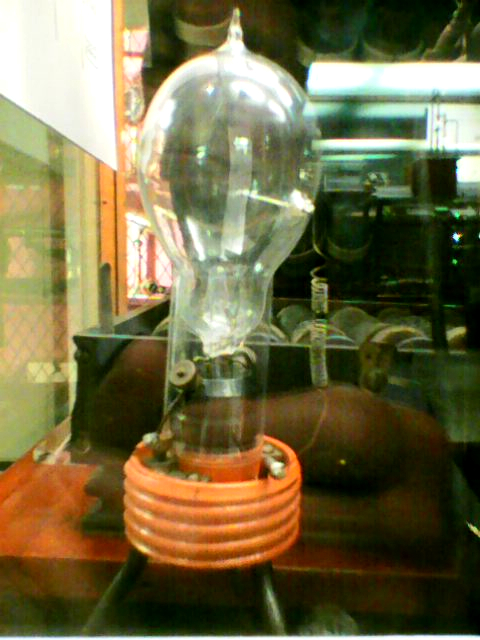
It was an original ‘Fleming Valve’. To us today, it is almost absurdly simple. A carbon filament electric light bulb (the filament in the shape of a horse-shoe) with a metal plate in between its two arms. Quite obviously (again, to us) it is a thermionic diode – a rectifier. Thermionic emission had been known for many years, and written up by various physicists (see Wikipedia); but it was Thomas Edison in 1883 who (AFAIK) first put a plate in the light bulb he had just developed, and discovered that a current of electricity could pass from the filament to the plate – but not in the opposite direction. Some of these Edison ‘lamps’ were brought to the U.K. in 1884/5 by William Preece, who made a presentation on the ‘Edison Effect’ as it was termed. Some years later, the noted physicist Ambrose Fleming (1849-1945), who was then retained as a consultant by the Marconi Company, tried out one of these ‘lamps’ as a Radio Frequency detector, and found that it worked well. The rest is history! To see an actual ‘lamp’ – perhaps, even, one of those brought here by Preece 130 years ago? – was a great thrill. It was almost literally the ‘Aladdin’s Lamp’ from which were descended the myriad types of thermionic valve (vacuum tube in the U.S.) that were to dominate the whole of electronics for the next 50 years – and are still going strong in high power applications.

By now mentally & physically exhausted, but spiritually charged up, we plodded back to Oxford railway station. A wrong turn took us past the old Oxford Jail – Gaol they used to spell it. It has a very long history, with which we are not concerned: but it was converted into a hotel in 2004. I played a gig there, part of the opening festivities – the viands served to the guests (the band was also permitted to partake) were the most luxurious & spectacular I have ever seen. Except, perhaps, when I did a gig at Prince Charles’s house for Camilla’s birthday party – but that’s another story… 8^)