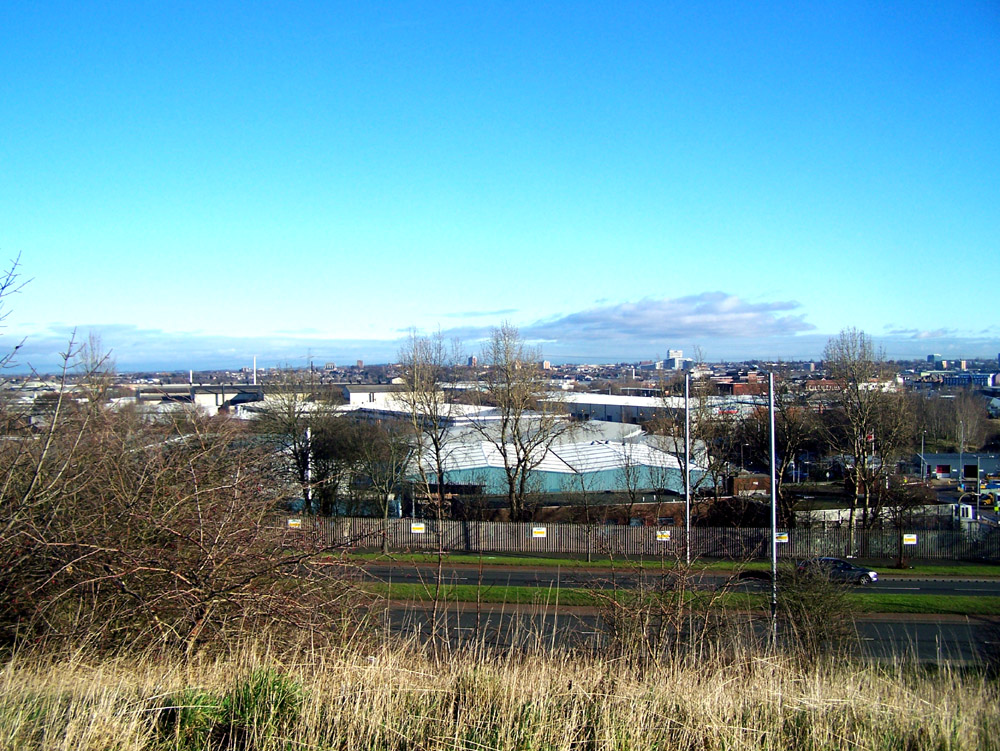
 11th January 2012. Once again, after two solid days looking into the PC monitor – we made and ‘tweaked’ over 100 scans of 78 record labels for our current project – it was time to escape again into the open air. The weather has continued astonishingly mild; yesterday the maximum temperature was 14 C! This morning had bright sunshine as well, so out – but not very far. Only about 5 miles from home, here we have a panorama of part of the Black Country, near Rowley Regis. It no longer has the smoke-belching chimneys & furnaces of previous times, but is still a hive of industry. It’s practically all industry, as far as the eye can see. So where is the nature reserve? Well, if we just turn the camera through 180 degrees…
 …we have open space. I doubt that it was always open space… there was certainly a mine of some sort along the escarpment to the right. Part of this area is the latest Nature Reserve of the Birmingham and Black Country Wildlife Trust – the BBC Wildlife Trust for short. The eminence in the distance, a landmark for many miles around, is Turner’s Hill, 880 feet above sea level (269m). So inevitably, it is furnished with two large communication masts, presumably of the microwave variety. The range of these must be very great – indeed, limited only by the curvature of the earth. H’mm. Lately, we seem to be visiting sites which are associated with telecommunications! Let us proceed up the path.
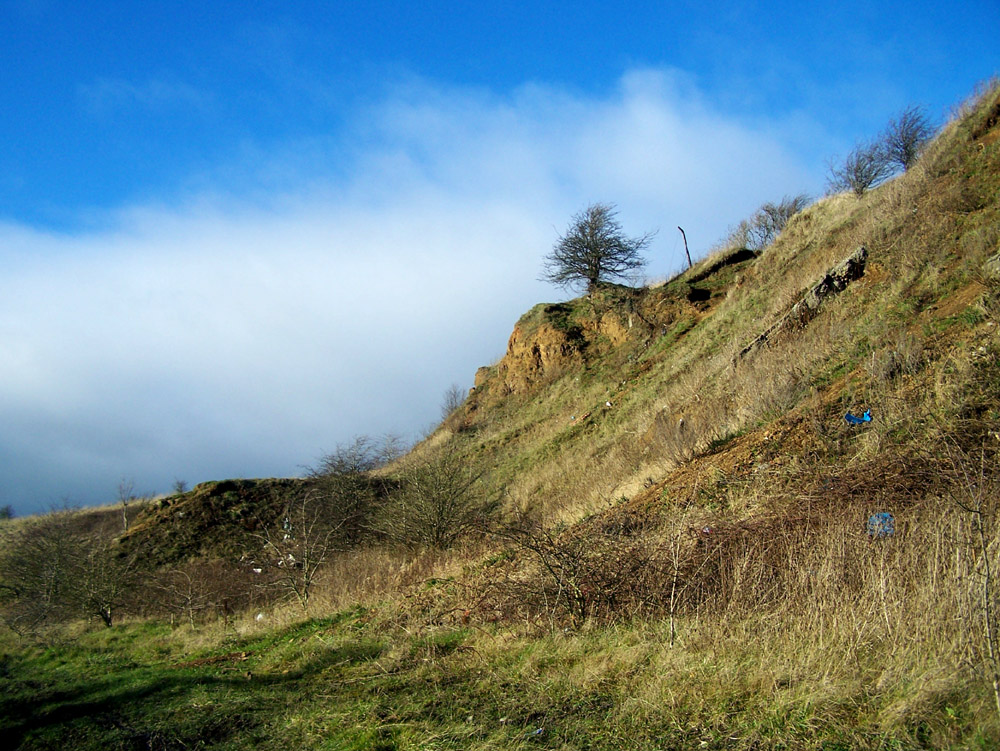 A sentinel tree looks down from the escarpment. My ignorance of geology is almost all-encompassing, so I don’t know what the escarpment is made of. It’s certainly not sandstone, because we have one of those quite near & I’ve often seen it and it looks like sandstone. This might be limestone… You see, the reason why the Black Country took off so well as an industrial area in the late 1700s was that all the ingredients you needed to make iron or steel were all at hand. Iron ore, limestone, and coal. Voilà! You didn’t have to move heavy minerals & stuff about, which was very expensive in those days. Or at least, you didn’t have to move it very far. People with wheelbarrows could probably cope quite well. 8^) Before moving on to the next image, I must comment on the amount of litter present. The blue things on the right, and the white bits on the little tree left of centre, are all old plastic bags. Obviously the wind blows a lot round here, & the plastic gets stuck on twigs, thorns &c. Most unsatisfactory.
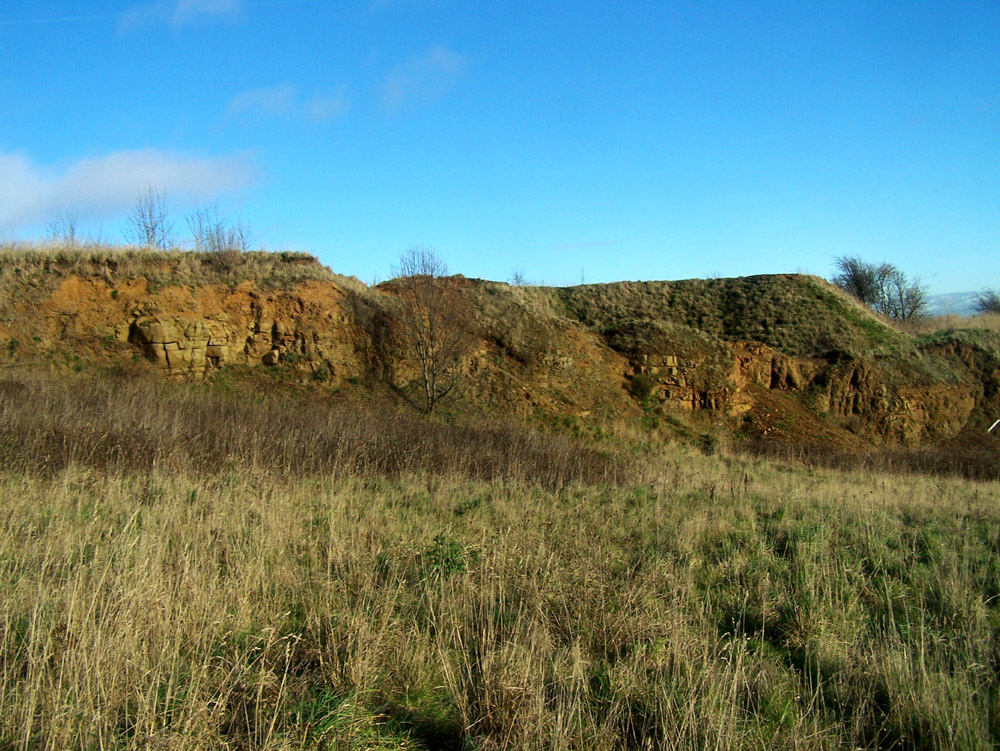 Another view of the escarpment. Unfortunately there’s nothing to give it scale, but it’s not very tall. Perhaps 10 or 15 feet at this point. Even I can tell that it has a very pronounced stratigraphy; possibly the bit at the left is sandstone over limestone. I should have chipped a bit off from the lower strata, brought it home & tested it with Hydrochloric acid. But I digress… the point is, that much (though not all) of this area is now a nature reserve, and it has an extraordinarily rich population of flora and fauna. I don’t know much about the flora, or the vertebrate fauna; but it is certainly very good for butterflies, and therefore also for moths. Here is a link here to photos. taken here recently: http://www.bbcwildlife.org.uk/node/3341 . To my astonishment, the Marbled White butterfly is found here. I have never seen one, so must return in due season.
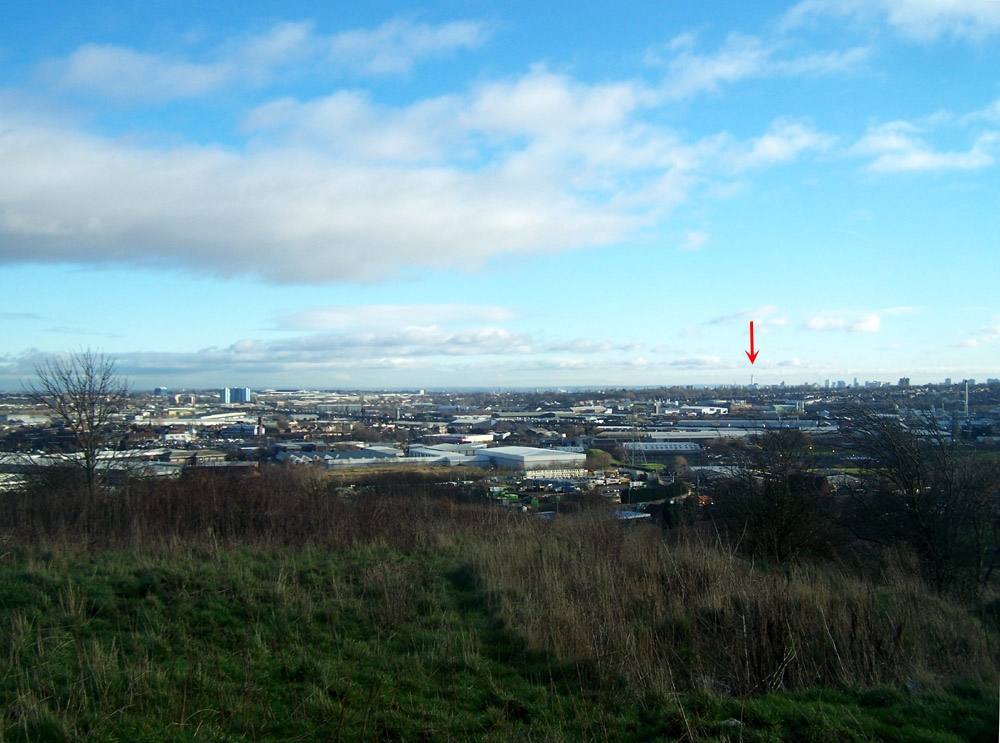 Walking back along the top of the escarpment revealed another, even more extensive panoramic view of the industrial enclave. The red arrow points to the Post Office tower in the centre of Birmingham. We saw this tower from another aspect in a recent Diary page. The high-rise stuff to the right of it represents the Birmingham city centre. It’s not far away, perhaps 5 or 6 miles or so. In short, Nature – or at least some of it – will survive, as long as it’s given a chance. The work of groups of individuals who are prepared to help in this process is therefore extremely precious. OK, I joined the BBCWT, and my sub. will help in a small way. But I must check to see when there will be some ‘tidying up days’. It would afford an increasingly feeble dotard like me, an opportunity to fill a few bags full of aluminium drinks cans – I must have seen 40 or 50 & I wasn’t looking for them – and so give a little help to one tiny but still irreplaceable fragment of natural habitat.
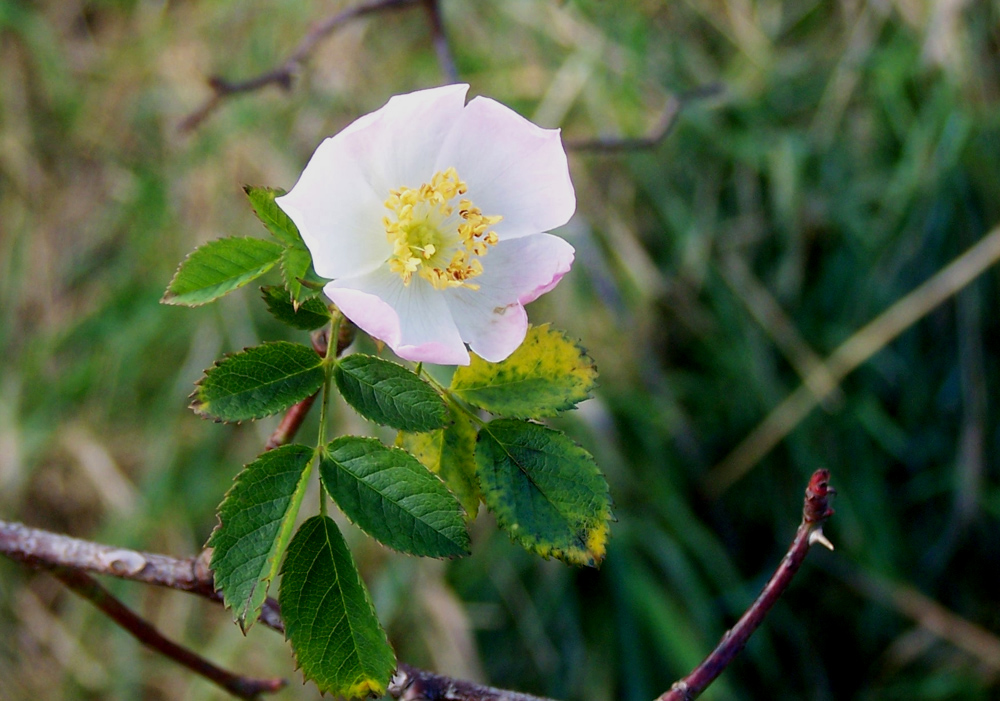 To end on an up-beat note, we saw this. Surely it must be the Dog Rose, Rosa canina? Or perhaps more likely the Field Rose, Rosa arvensis? In any event, those are supposed to flower between June and August, not on the 11th of January! What does it mean?
(Note added 1st January 2020: It means GLOBAL WARMING!)