 Date Here. We had come to Wolverhampton from Birmingham by the Metro. My mother’s family were Wolverhampton, & I grew up here. We’re looking along Lichfield Street, to the intersection with Princess Street, coming from the left, and continuing to the right into Stafford Street. Three red traffic lights gleam balefully at us. So what is the purpose of this shot? Well, I was always told as a kid, that this intersection was the very first place that traffic lights were ever tried out in the UK. In 1926, IIRC. Certainly, when I was young, there was a little bollard in the middle of the junction, which had illuminated blue glass plates, with white lettering which said: ‘TURNING RIGHT, KEEP RIGHT’. I wonder what happened to it? In any event, traffic lights were, as we all know, an enormous success, and there are countless millions of them today. We celebrated this by having our bacon sandwich & a large mug of tea.
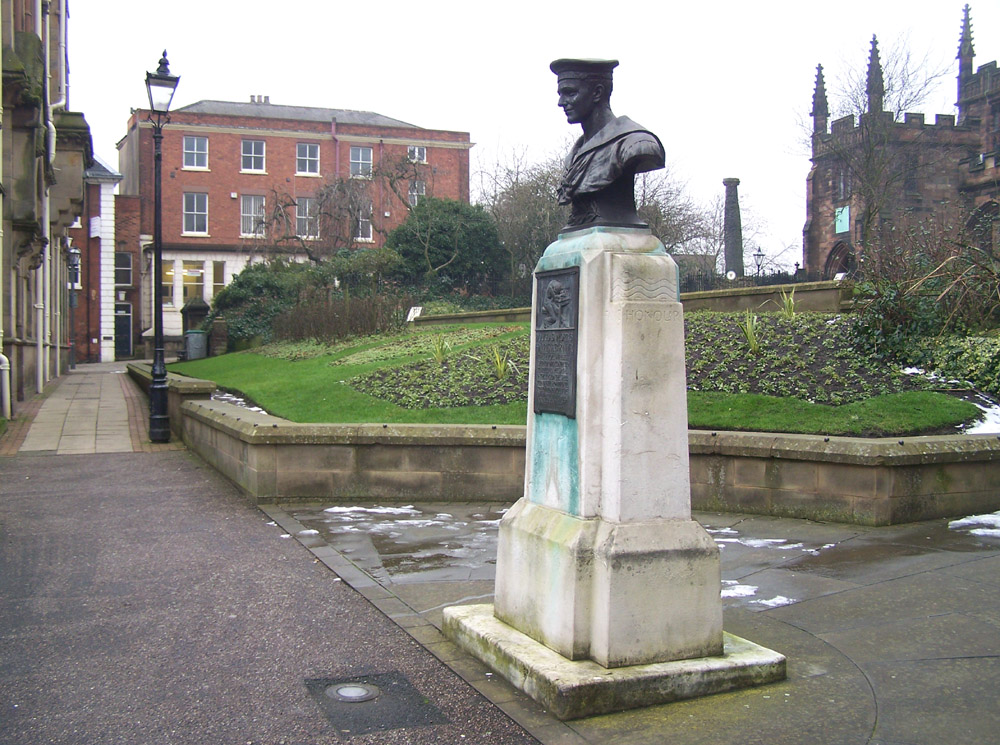 Here a poignant moment. As a child, when my grandfather would take me ‘up town’, I would always look at this modest but thought-provoking monument in the gardens near St. Peter’s Church. There was something peaceful and reassuring – inspiring – in the face of poor young Douglas Harris, who met his death in the Adriatic Sea in 1917, on a vessel sunk by enemy gunfire. He was the wireless operator; but read for yourself…
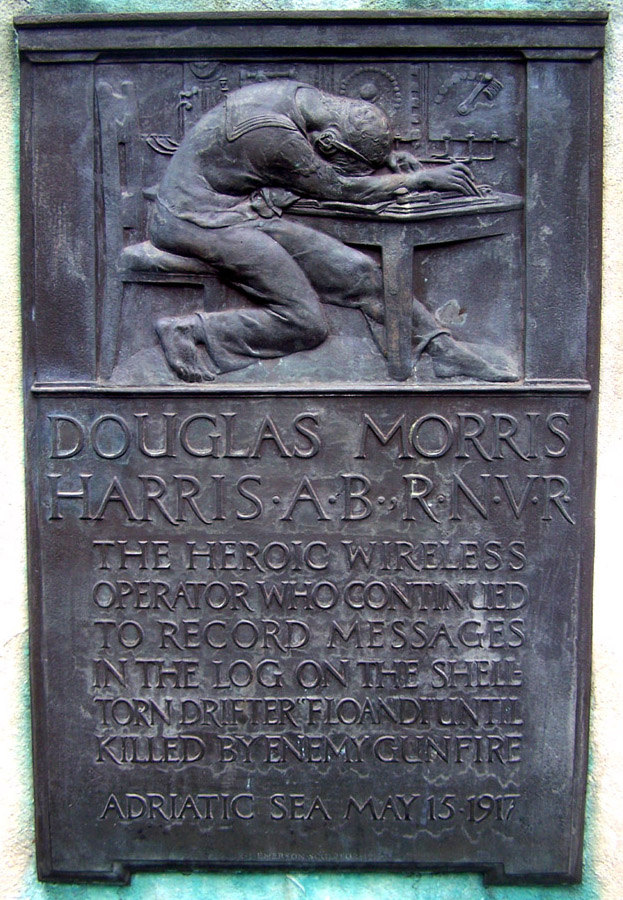 “He died doing his job: which he did far above and beyond the call of Duty.” I simply don’t know how they did it, and in their hundreds of thousands: in their millions. Douglas Harris was just 19 years old when he was killed. Read more about him on-line. And now meet him…
 I have long had the theory – by which I mean all that follows is my opinion alone – that many of the tribute sculptures produced in the aftermath of the Great War, mostly done in the early 1920s, are some of the most beautiful, human, realistic and inspiring works of art ever made. A subtle balance seemed to prevail, briefly, at this time. The over-inflated pompous grandiosity of the Victorian epoch had been laid aside; but the remorseless march of the abstract movement in art was still deemed inappropriate in tributes to The Fallen. Accordingly, artists (especially sculptors I think) attained the greatest heights in depicting, either actually or symbolically, the aspect, appearance and humanity of their subjects; whether they were real individuals (as here), or as composite allegorical figures, e.g. the four bronzes to be found around the Hall of Memory in Birmingham. As a child who as yet knew nothing, I learned to somehow trust this figure, and, without knowing it, benefited from the timeless assurance and composure that the sculptor Robert Jackson Emerson had embodied in it, when he created it in 1919. Time has brought many changes. After World War II, other things were created as tributes and symbolic memorials to The Fallen, such as Coventry Cathedral. I was still only 18 years old when the new Coventry Cathedral was consecrated in 1962. I thought it was horrible then, and still do. Being elderly & conservative, it could hardly be otherwise, I suppose. And again, that new cathedral was simply a ‘Product of its Time’, just like the bronze above.